You need a Rockford asphalt contractor with expertise in local soil conditions and freeze-thaw cycles, offering complete services from concept to completion. Demand ground analysis, compression analysis, professional drainage design, proper mix designs, thermal monitoring, and confirmed density measurements. Demand detailed work specifications, unit pricing, detailed timelines, weather-delay criteria, and traffic management meeting MUTCD standards. Confirm Illinois licensure, insurance, safety-certified management, performance-based guarantees, and history with equivalent installations. Obtain references, long-term performance data, and modification records to ensure long-term quality-more awaits ahead.
Core Takeaways
- Choose a reliable Rockford contractor with proven cold weather experience, strong municipal relationships, and quick-acting crews for weather-related and emergency services.
- Offer complete capabilities spanning design to striping for municipal, commercial, and residential projects, including ADA standards, traffic control, and evening work solutions.
- Require thorough QA/QC: covering compaction and soil analysis, drainage planning, density verification, and detailed punchlists throughout paving installation.
- Request transparent quotes that include detailed specifications including quantities, mix designs, thickness requirements, project milestones, weather policies, pricing per unit, exclusions, and milestone-based billing.
- Validate professional standing: verification of Illinois licensing, insurance coverage and bonding through insurers, references from local clients showing 1-, 3-, and 5-year success metrics.
Why Choosing a Local Rockford Asphalt Expert Matters
While national paving companies might seem attractive, a local Rockford asphalt specialist delivers the precision and attention your project demands. You benefit from local expertise based on Rockford's unique soil conditions, weather cycles, and local regulations, guaranteeing your pavement design, mix selection, and installation approach suit real-world requirements. Your contractor's community relationships expedite documentation requirements, quality checks, and infrastructure planning, reducing setbacks and rework.
You also gain quick assistance. When weather changes occur get more info or mechanical difficulties emerge, a local crew responds swiftly, adjusts schedules, and safeguards fresh layers before density or surface texture are compromised. Should you experience emergency maintenance issues-potholes, raveling, or failed joints-a local team secures the area, enhances ride quality, and decreases liability promptly. You receive responsibility, clear communication, and outcomes that deliver season after season in Rockford.
Complete Paving Services for Residential, Commercial, and Municipal Clients
From planning to completion, we provide a complete paving solution customized for your specific needs and budget-whether it's a driveway, retail lot, industrial yard, or city roadway. We engineer pavement sections to meet traffic loads, climate, and life-cycle targets, then deliver on schedule with minimal disruption.
For homeowners, we create smooth, long-lasting paving solutions, including green solutions like permeable driveways that minimize runoff and align with local stormwater standards. For businesses, we offer new construction, mill-and-overlay, crack sealing, sealcoating, ADA-compliant improvements, phasing plans, and night work to keep customer access. When serving municipalities, we manage arterials, alleys, and bike paths with comprehensive specifications, traffic control, and pavement markings that meet MUTCD standards. You'll obtain detailed documentation of materials, compaction reports, and warranties that secure your investment.
Why You Need Site Preparation and Water Management
You protect your pavement investment by starting with comprehensive soil evaluation, verifying load-bearing capacity, compaction targets, and freeze sensitivity. We then grade to designated slopes and tolerances, establishing elevations that push water away from facilities and pavement boundaries. With carefully planned drainage-foundation layers, perimeter drainage, and correctly specified inlets-you avoid ponding, minimize freeze-thaw damage, and prolong service life.
Understanding Soil Evaluation Fundamentals
Prior to ordering asphalt materials, an in-depth soil evaluation establishes the foundation for durable pavement solutions. It's essential to understand what's underneath your project, how it responds under load, and how it will sustain the base course. We initiate with soil analysis to identify classification, moisture content, and plasticity index. This information determines our approach regarding substrate reinforcement, undercutting, or geotextile reinforcement.
Subsequently, we verify soil strength and consistency through density testing, verifying that specified density levels are met and uniform across the site. We evaluate ground conditions, locate weak areas, and validate lift thicknesses align with design. Proper grading tolerances are monitored to prevent inconsistent support and early failure. With reliable testing, calibrated equipment, and documented results, you get a reliable, even subgrade prepared for long-lasting pavement stability.
Smart Water Management
With the subgrade verified and stable, water control becomes the next performance driver. It's essential to establish precise grading that provides effective water flow away from structures and channels runoff to designated drainage paths. We configure surface levels to preserve appropriate cross-grades, eliminate standing water, and protect the pavement structure from moisture damage that causes premature fatigue and surface breakdown.
We integrate drainage solutions that align with your site's hydrology. Drainage components move water quickly, while natural drainage channels slow, filter, and infiltrate flows to decrease peak discharge. Where feasible, permeable paving adds storage and infiltration, decreasing load on storm sewers and enhancing winter performance by minimizing surface ice. We select geotextiles, base gradations, and outlet locations to prevent material displacement. The result: extended surface longevity, minimal follow-ups, and reliable maintenance needs.
Asphalt Installation Best Practices for Durable, Smooth Surfaces
While each project location has its own characteristics, durable , smooth asphalt depends on disciplined preparation and tight process control. You achieve predictable results by validating subgrade stability, exact grading, and required densities before paving begins. Specify the optimal mixture design for vehicle load, environmental factors, and course thickness; we verify appropriate binder grade and aggregate gradation to minimize material separation and deformation.
During placement, temperature control is non-negotiable. We consistently check haul, mat, and screed temperatures to ensure proper compaction parameters and prevent thermal cracking or tenderness. Execute proper compaction procedures-establish rolling patterns, ensure roller compatibility with lift depths, and obtain proper density using precision equipment. Execute joint construction with properly aligned edges, tack application, and appropriate edge overlap to lock seams, prevent permeability, and create a smooth finished surface.
Extending Pavement Lifespan Through Sealcoating and Maintenance
Protect your investment and prevent oxidation with professional sealcoating that blocks sunlight, precipitation, and ice-melting agents. Prevent moisture penetration and foundation issues by treating developing cracks with flexible, heat-applied sealants specifically selected for crack dimensions. We'll determine the best materials and schedule so your pavement performs longer, stays attractive, and minimizes maintenance costs.
Advantages of Sealcoating
Strategic sealcoat application, together with regular maintenance and crack repair, protects your pavement from harmful elements like UV rays, moisture, oxidation, and winter chemicals while prolonging service life. You receive UV protection that reduces binder breakdown, reduces raveling, and sustains asphalt flexibility under Rockford's freezing and thawing conditions. The protected pavement resists water intrusion, reducing pothole formation and base destabilization.
Sealcoating offers a uniform, deep-black finish that enhances visual appeal and line marking clarity. It effectively reduces damage caused by vehicles and winter maintenance, while lowering lifecycle costs and prolonging rehabilitation timeframes. The enhanced surface enables more rapid snow clearance, improving winter safety. Regular applications based on vehicle load and climate factors optimize performance and budget planning, maintaining your surface in prime condition longer.
Expert Crack Sealing
After sealcoating, proper crack sealing focuses on the primary route for water infiltration and pavement failure. You prevent subbase erosion by cleaning, routing as necessary, and treating cracks before moisture and deicing chemicals penetrate. We assess crack size, movement, and concentration to select the right material and method.
When dealing with active cracks subject to thermal movement, we suggest using hot-applied polymer sealants with suitable overbanding to ensure flexibility and strong adhesion. In cases of narrow, low-movement cracks or cool weather, we utilize cold-application sealants that cure quickly and minimize downtime. Thorough crack preparation is crucial: dry surfaces, compressed-air cleaning, and temperature-controlled application maintain bonding strength.
You'll experience decreased raveling, reduced potholes, an improved ride, and longer service life, lowering life-cycle costs while protecting your new sealcoat investment.
How to Review Contractor Qualifications, Background, and References
Before finalizing a paving agreement, ensure that your Rockford asphalt contractor maintains current Illinois licensure (where applicable), appropriate insurance coverage, and necessary bonds; then verify these documents straight with the insurance provider. Conduct formal license checks and ask for certificates of insurance listing you as certificate holder.
Evaluate experience through a detailed portfolio review: request photographs of projects, scope summaries, paving details, material formulations, and equipment inventories. Request information on comparable jobs in Rockford's environment, incorporating cold weather durability and upkeep outcomes at 1-, 3-, and 5-year marks. Review field supervision background-foreman tenure, safety training, and industry certifications.
Meticulously review references. Get in touch with municipal representatives, owners, or property managers. Inquire about schedule compliance, site safety standards, how often change orders occur, density measurements obtained, storm water management effectiveness, and completion of punch list items.
Direct and Clear Estimates, Scheduling, and Project Communication
Once qualifications and previous work are verified, you should receive equal diligence regarding how a Rockford asphalt contractor manages the planning, costing, and implementation of your project. Request a thorough written scope covering volume requirements, mix specifications, dimensions, traffic management, drainage solutions, and disposal procedures. Demand price transparency: unit pricing, labor expenses, equipment rates, setup costs, allowances, and limitations. You must be provided an comprehensive schedule showing critical stages-subgrade prep, paving windows, compaction, cure times-and well-documented dependencies.
Define communication standards before project kickoff. Appoint a single project manager, determine meeting schedules, and define escalation procedures. Put in place daily project tracking, formal modification protocols, and weather-related postponement guidelines connected with rescheduling policies. Verify QA/QC steps: compaction testing, yield checks, and final inspection lists. Align payment schedules to concrete milestones, not arbitrary percentages. This structured discipline protects both budget and timeline.
Lasting Value: Warranties, Maintenance, and Care Guidelines
While paving quality creates the foundation, enduring value stems from solid warranties, swift repairs, and consistent maintenance. Make sure to ask for written warranty documentation that explicitly defines warranty coverage, workmanship details, materials, and warranty periods for each paving component. Connect these terms to quantifiable metrics like compaction testing and temperature documentation.
Handle cracks and raveling quickly. Use sealant on cracks measuring less than 1/4 inch, address broader cracks with appropriate sealing, and repair damaged areas with properly applied , compressed hot mix. Start sealcoating after allowing adequate curing periods, and avoid excessive sealing.
Implement upkeep routines based on traffic volume, weather exposure, and drainage parameters. Keep edge support, clear water collection points, and apply appropriate coatings. Perform regular assessments, implement infrared thermal repairs when feasible, and document all actions to ensure warranty validity.
Common Questions
What Permits or Zoning Approvals Are Required for My Paving Project?
You typically need proper building and zoning permits and approval for any work impacting shared access areas. Always confirm right-of-way permissions for driveway installations and utility placements. Ensure compliance with stormwater management, erosion control systems, and plans for managing traffic on public roads. Assess and validate setbacks, lot coverage, and permeability requirements. Submit detailed construction documents, specifications, and timeline. Don't begin work until official approvals are issued and inspections are arranged.
How Do Weather and Temperature Windows Affect Project Start Dates
Similar to a precision timepiece, environmental conditions and temperature thresholds dictate the starting window. The project demands clear weather, reliable weather forecasts, and environmental and ground temperatures typically between 50-90°F. Winter conditions create timing limitations, prolonging drying periods and pushing back mobilization; high temperatures may necessitate evening work to manage mix temperature and achieve correct compression. Precipitation threatens surface integrity and risks structural flaws, so we coordinate around precipitation. We track weather patterns and local conditions to establish the soonest reliable beginning.
Do You Provide ADA-Compliant Solutions for Parking Areas and Pathways?
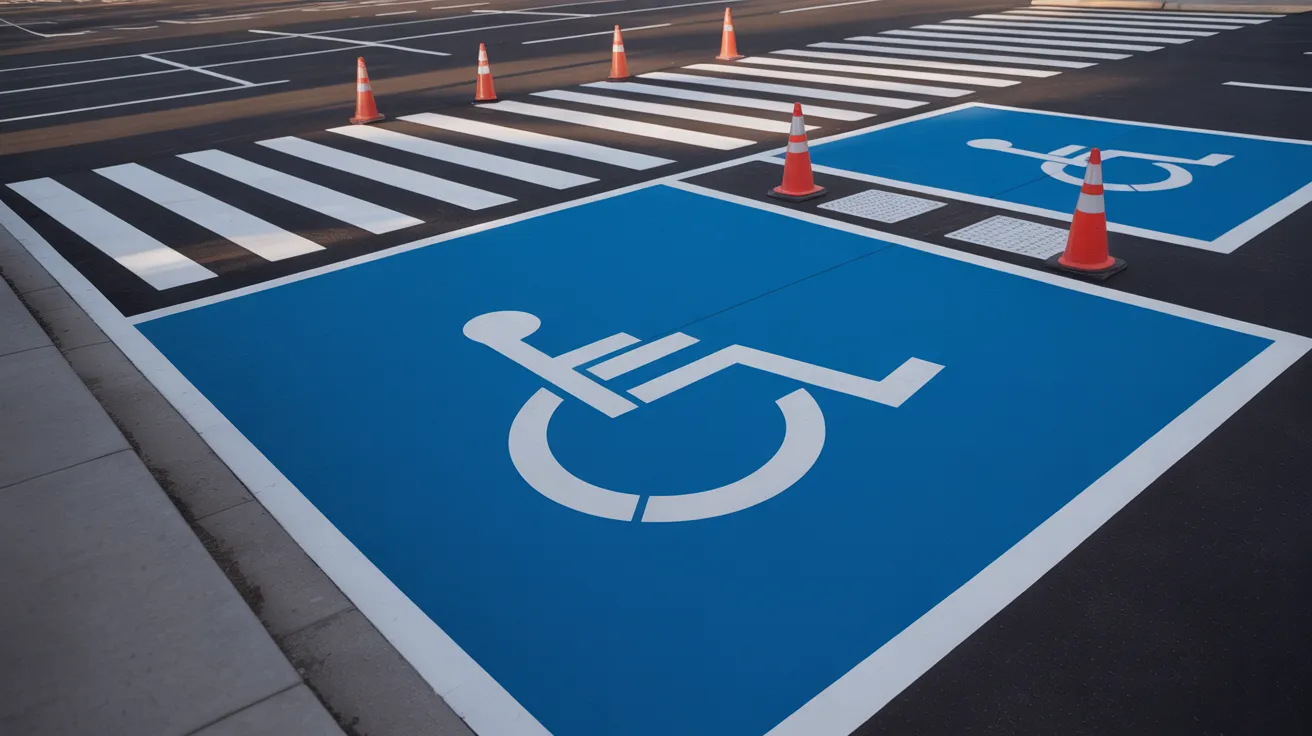
We provide complete ADA compliance services for parking facilities and pedestrian paths. You'll get proper slopes, cross-slopes, and widths; appropriately placed accessible parking stalls with van-access aisles; code-compliant signage and pavement markings; continuous accessible routes from parking to entrances; and detectable warnings with tactile indicators at crossing points and ramps. We confirm grades using laser levels, detail changes in level, and manage inspections to meet all regulatory requirements while minimizing interference.
How Are Old Asphalt Materials Recycled and Disposed Of?
Our closed-loop approach delivers optimal results: our team cold mills the current pavement, separate and classify quality RAP for reuse and blend it into fresh hot-mix according to DOT gradation specifications. We thoroughly test contaminants, binder content, and moisture ratios before mixing operations. In millings applications, we densify filtered millings for base construction or low-traffic areas, adding stabilization as needed. All unsuitable debris is delivered to certified facilities with detailed tracking. We optimize hauling efficiency, maintain effective dust suppression, and document all material quantities for full compliance verification.
How Does Construction Affect Adjacent Properties and Access During Projects
Construction work will have a temporary effect on neighboring properties and access, but you'll maintain entry; we'll arrange activities to provide interim entry and visible pathways. To manage noise concerns, we implement noise control methods: optimized machinery, restricted working hours, and acoustic barriers where necessary. We'll provide advance schedules, delivery path diagrams, and planned delivery arrangements to prevent bottlenecks. We'll preserve adjacent surfaces, control dust with water trucks, and maintain ADA-compliant paths. Any access disruptions are short, organized, and well-documented.
In Summary
Choosing a reputable Rockford asphalt contractor sets up your project for lasting results and value. You'll benefit from accurate grading, effective drainage, and ASTM-compliant installation that resists surface damage. Here's a significant statistic: timely sealcoating can extend pavement life by up to 50%, reducing lifecycle costs dramatically. When you insist on detailed estimates, credentialed crews, and proactive maintenance plans, you safeguard your investment. Work alongside a local expertand receive quality, reliability, and professionalism from day one.